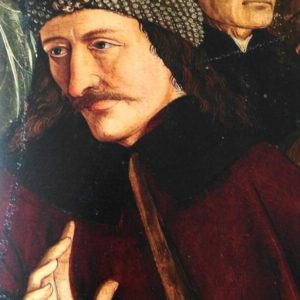
With an almost entirely religious purpose—namely, that of defending the Church against the Hussite heretics—and against the backdrop of wars fought for control of Bosnia, Sigismund I of Luxembourg and his second wife, Queen Barbara von Cilli, with the support of a large part of the Hungarian nobility, led by the Garai and Celje families, founded on 12 December 1408 (possibly on 13 December), most probably at Viglas Castle, the Order of the Dragon Reversed.
To this day, however, the exact date of the Order’s foundation remains a matter of historical debate. Some historians attribute its foundation to 1 December 1387, while others date it to 1418.
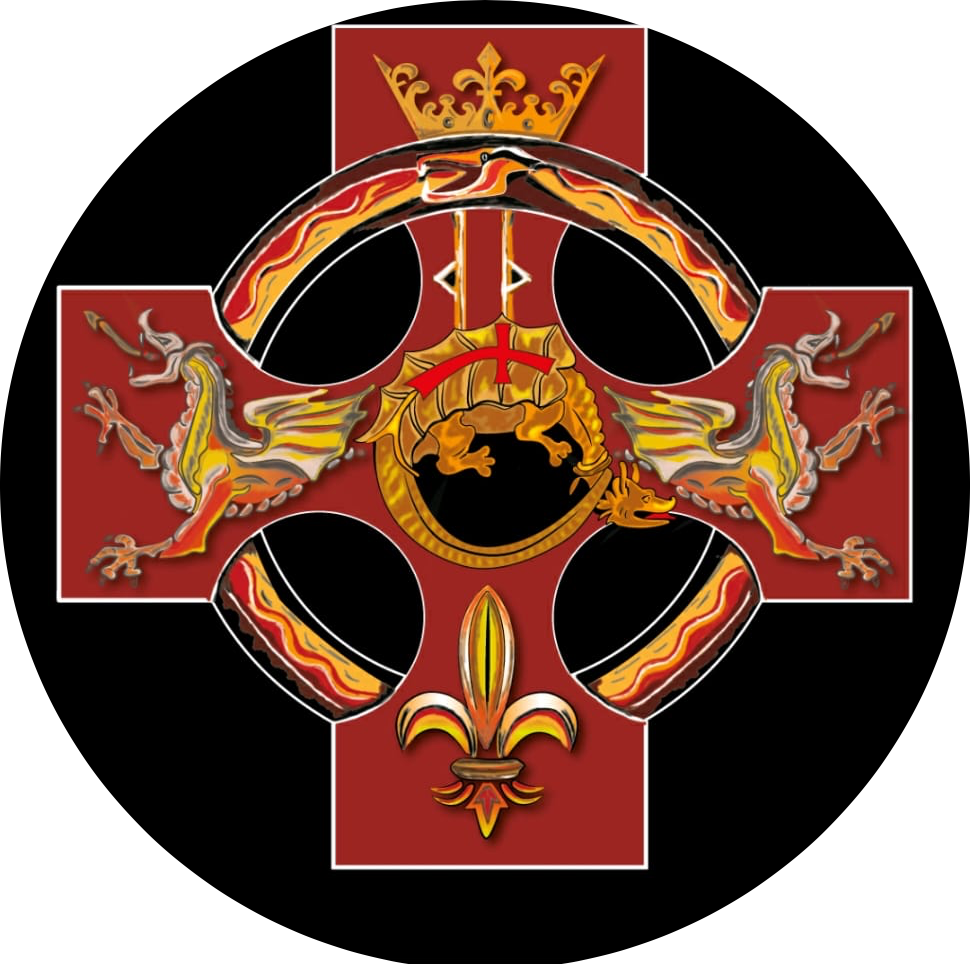
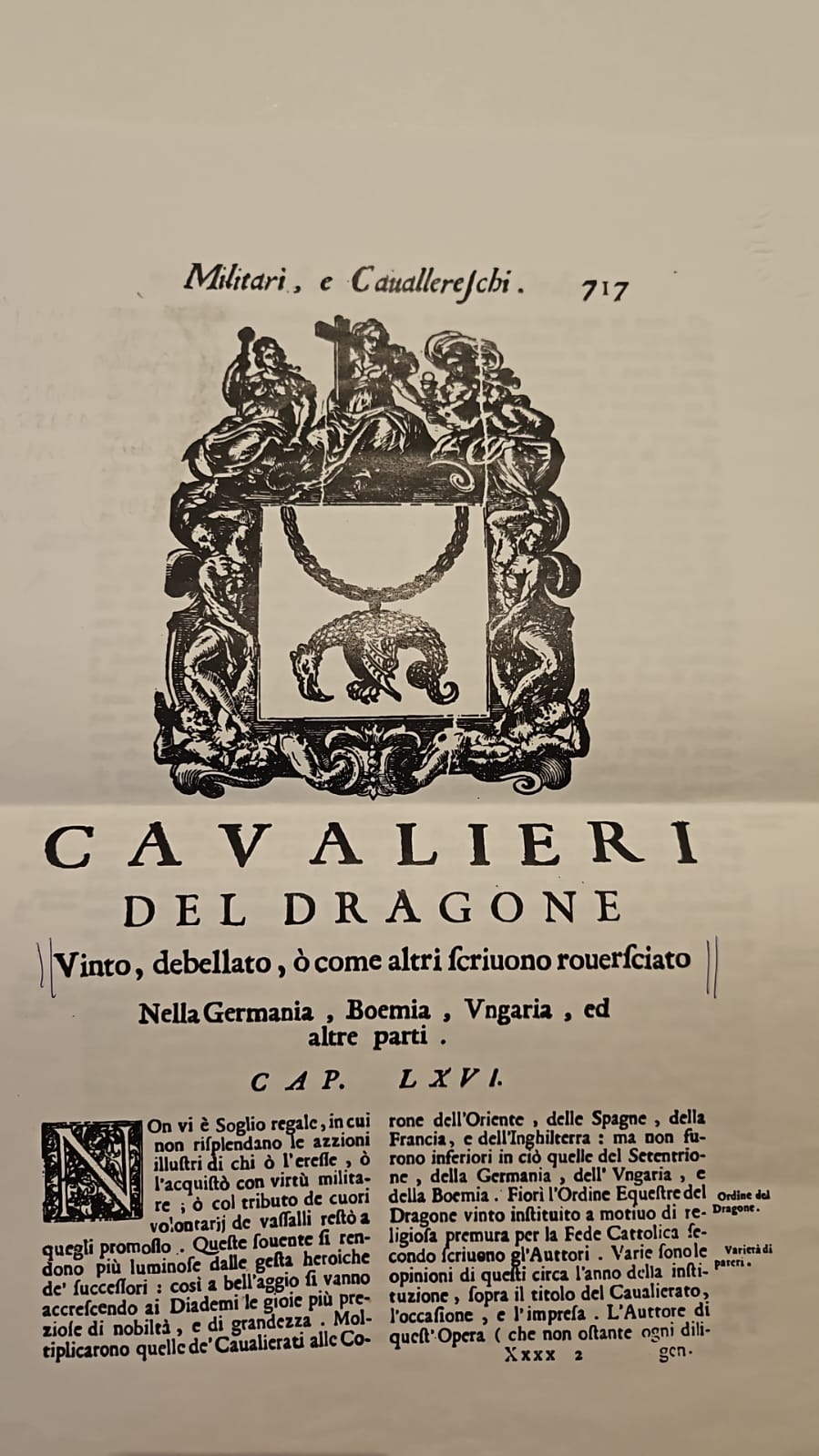
The Order of the Dragon adopted as its emblem a dying dragon turned upon itself, with a cross at its centre. This symbol was intended to represent the triumph of Catholic orthodoxy over heresy and evil, as well as the defeat of the infidels and heretics that was expected to follow shortly thereafter.
Its members wore the emblem around their necks as a pendant and, over their armour, a long scarlet tunic and a green cloak, symbolising the dragon’s skin and its bloodied belly, fastened with a clasp.
The authentic insignia of the Order are currently exhibited at the former Staatliche Museum in Berlin and at the Bayerisches Nationalmuseum in Munich.
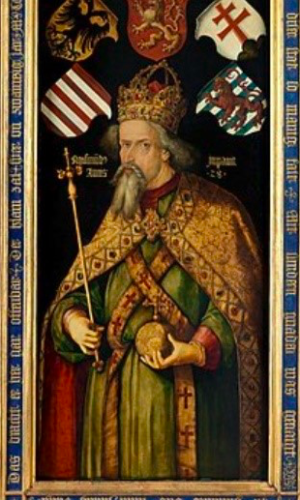
The German name for this order was ‘Drachenordens’ and in Latin ‘Societatis draconistrarum or draconistarum’.
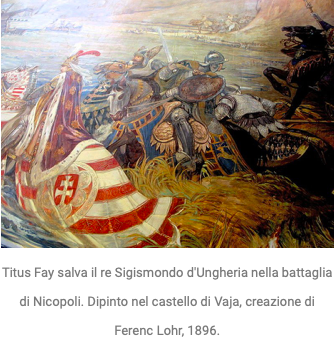
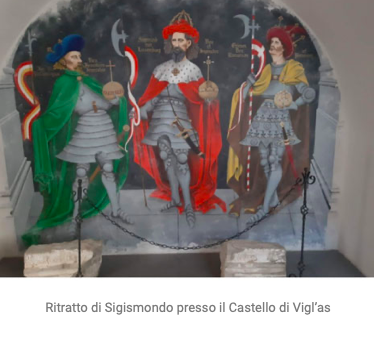
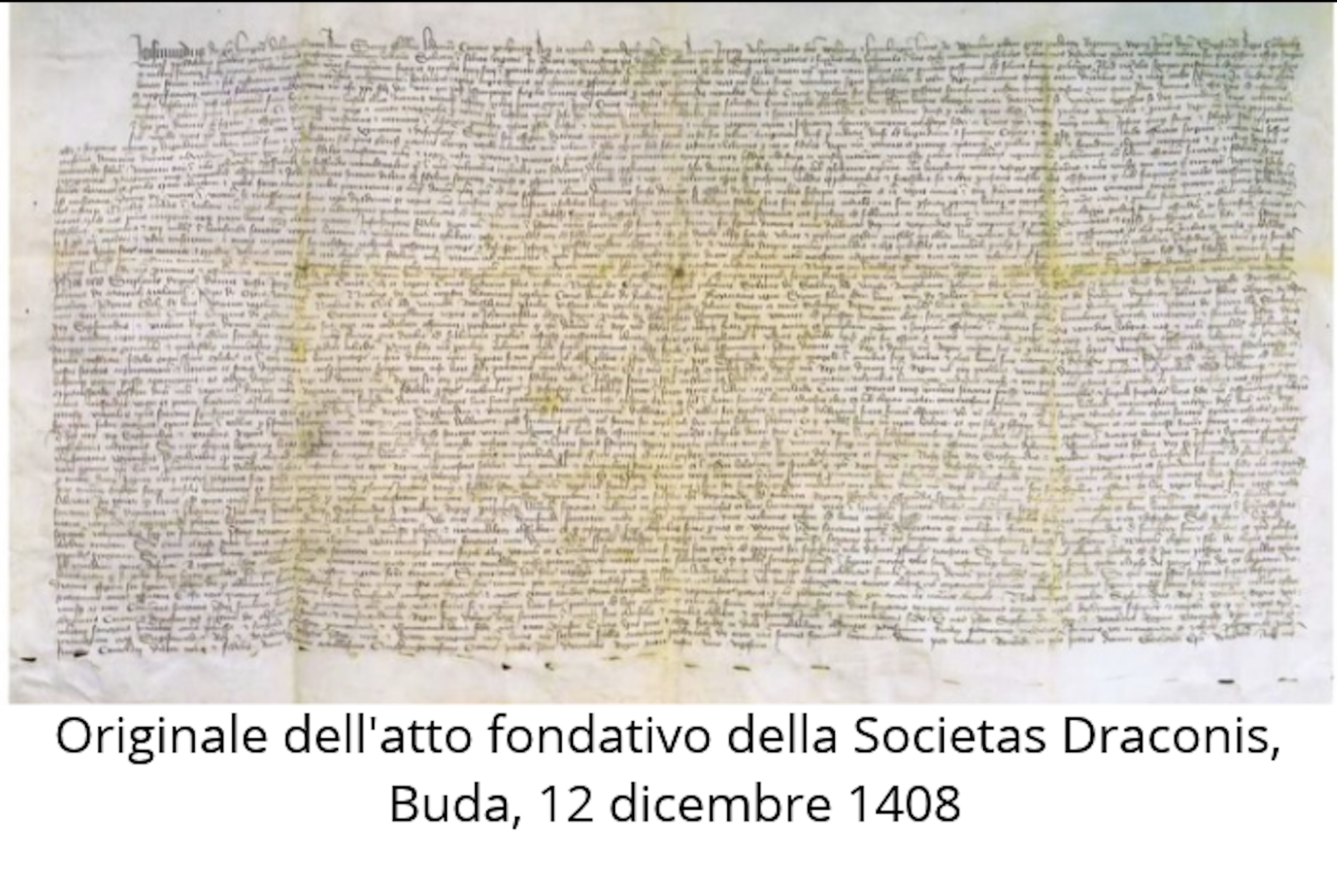
Its acts, written in Latin, refer to it as a societas (society), whose members bear the signum draconis (Sign of the Dragon), but they do not assign it any official name. Contemporary documents, however, refer to the Order by a variety of similar, although unofficial, names, such as Gesellschaft mit dem Drachen, Divisa seu Societas Draconica, Societas Draconica seu Draconistarum, and Fraternitas Draconum or Draconis. To some extent, the Order was modelled on the earlier Hungarian monarchical order, the Order of Saint George. The Order of the Dragon, which some mistakenly regard as merely a decoration, was in fact an institution, just like the other chivalric orders that emerged during the medieval period. Its creation formed part of the broader practice of establishing chivalric orders during the fourteenth and early fifteenth centuries, which were not infrequently devoted to organising “crusades”, particularly in the aftermath of the disastrous Battle of Nicopolis (1396). Sigismund’s Order was particularly inspired by the Order of Saint George of 1318 (Societas militae Sancti Georgii), founded by King Charles I of Hungary in 1318, the grandfather of Sigismund’s first wife, Mary. Another influential model may have been the Sicilian Order of the Ship, founded in 1381. The Order spread rapidly throughout Eastern Europe, particularly in Bohemia, Hungary, Poland and the Danubian Principalities (present-day Romania). It subsequently spread to Germany, Austria, Italy and Spain. Kings, barons, priests and leaders of the realm gathered under the sign of the Dragon beneath the Cross and proclaimed their allegiance to King Sigismund and his Queen. On 21 July 1433, in response to a petition submitted by Emperor Sigismund, Pope Eugene IV granted the members of the Societas Draconis a plenary remission of the penalties and sins associated with participation in the crusade against the infidels. Subsequently, on 24 July 1433, Pope Eugene IV, again in response to another petition submitted by Sigismund, approved and confirmed the amendment of the statutes of the Societas Draconis, by means of the provision “Fiat ut petitur” — “Let it be done as requested.” Sigismund did not ask Eugene IV to create a new institution. In the document, he explicitly states that he had “quandam societatem laudabilem cum signo draconis fundavit”, that is, that he had founded a “laudable society bearing the Sign of the Dragon”, and specifies that he had issued statuta for the members of the society, regulating their religious and behavioural obligations. It follows that, in 1433, the same institution was presented before the Pope as a societas, possessing its own statuta, its own socii (members), and its own iuramentum (oath). This provides substantially stronger historical grounds for understanding the institution as a confraternal or corporate society, rather than merely through the modern definition of a “chivalric order”. It is therefore historically defensible to state that, at the foundation of the Dragon institution, there existed a society or fraternity governed by statutes, which was subsequently recognised and subjected to papal intervention.
The Statutes of the Order, which were expanded by Bishop Eberhard of Nagyvárad, Chancellor at the court of Sigismund, survive only in a copy made in 1707. This copy was published in 1841 in an edition of the Codex Diplomaticus Hungariae Ecclesiasticus ac Civilis, yet the Statutes have remained largely unknown.
An analysis of this important document shows that the Order was established with the purpose of defending the Cross, symbolised by the ancient dragons (Draconis tortuosi), with the assistance of Saint George; defending the Hungarian monarchy against both foreign and internal enemies; and defending the Catholic Church against heretics and pagans, particularly those who had embraced the doctrine of the heretic Jan Hus (the Hussites), as well as the forces of the Ottoman Empire.
Today, the known archival materials relating to the Order are preserved within the archives of the University of Budapest.

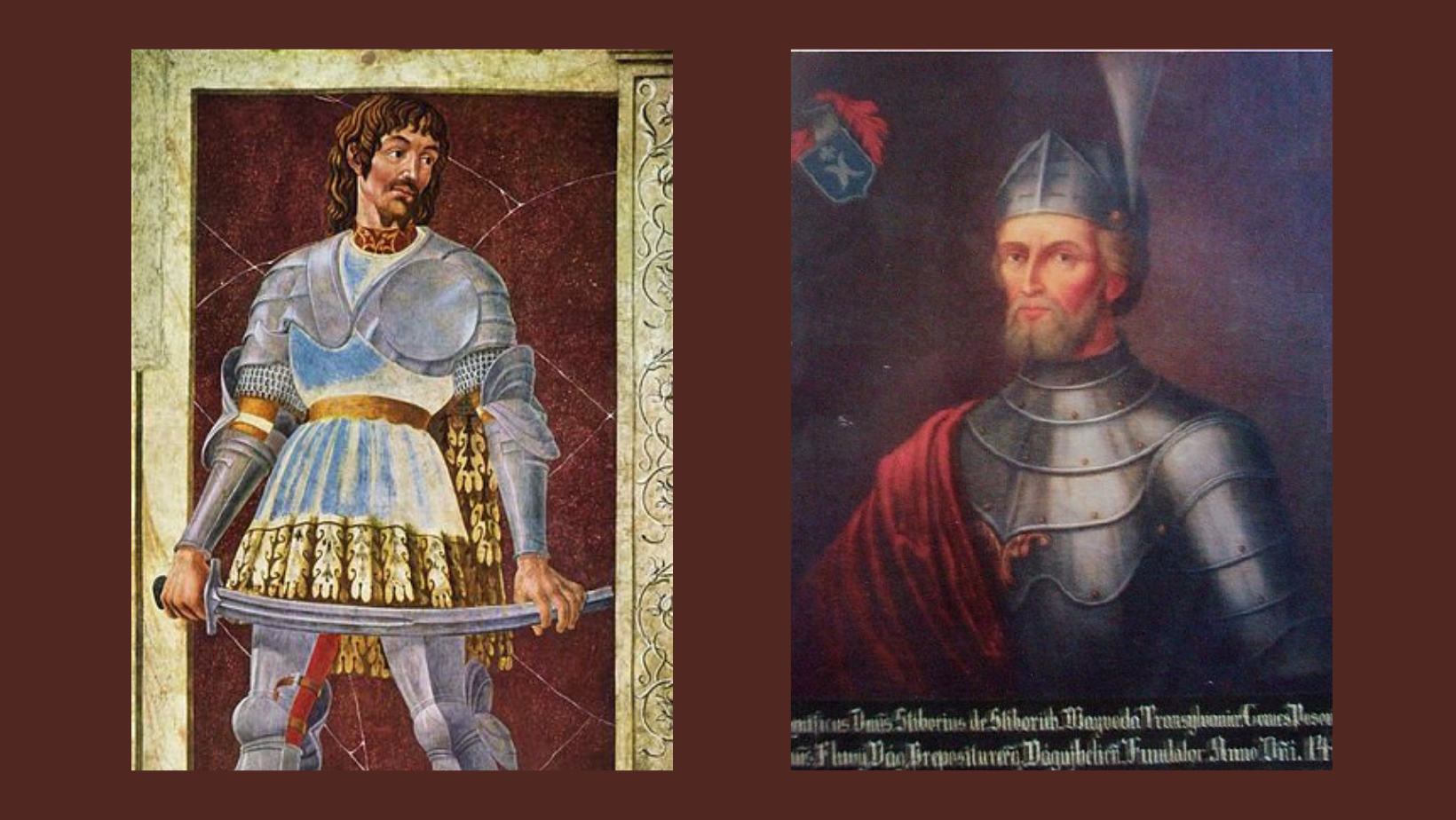
From the left:
Pippo Spano e Stefan Lazarec
The members of the Order are referred to in the Statutes as barones (occasionally socii), which is why, even in 1431, the year in which the statutes of the confraternity were confirmed, the title of Knight did not appear among the requirements for admission to the Order.
They were predominantly political allies and supporters of Sigismund, initially drawn largely from the political factions associated with Stefan Lazarević, Nicholas II Garai and Hermann II of Celje. Among them were prominent magnates and figures such as Stibor of Stiboricz, Pippo Spano, John Tamási, Ban of Severin, Alfonso V of Aragon, the Venetian ambassador Pantaleone Balbo, Henry V of England, and King Christopher III of Denmark.
Of particular importance for the restoration of the Order and the preservation of its historical continuity was Jacob Lackfi (Lackovic), Voivode of Transylvania and Ban of Banat, whose residence was located in the town of Rachita (Romania).
The initial group of recruits to Sigismund’s Order consisted of 21 men, later increasing to approximately 24 by 1418.
For the first 24 Knights of the First Circle, the Dragon is depicted beneath the symbol of the Cross of Fire, whereas for the other Knights, the Dragon is represented without the Cross inscribed in Latin.
Sigismund chose as patron saints Saint George, Saint Michael the Archangel, and Saint Margaret of Antioch. According to the Legenda Aurea, they were swallowed by the flesh of a dragon but, by the grace of God, were cast out unharmed.
The Dragon of the Order is depicted with its tail wrapped around its neck, symbolising the power of sacrificing one’s own life. Although the reason for choosing the image of the Dragon may appear unusual, since in traditional Christian heraldry the Dragon is associated with evil power defeated by Saint George, in the heraldry of the Order of the Dragon it symbolically represents the soul of a knight who gives his life to save another soul, thereby conveying an impressive image of strength and determination.
Across the back of the Dragon, on a white band symbolising the blood shed in self-sacrifice, a red cross is depicted, recalling the crossed white banner as a symbol of Christ’s victory over death after the Resurrection. Above the Dragon there is another golden cross. After 1418, the Order adopted the motto: “O quam misericors est Deus, justus et patiens.” “Oh, how merciful God is, just and patient.”
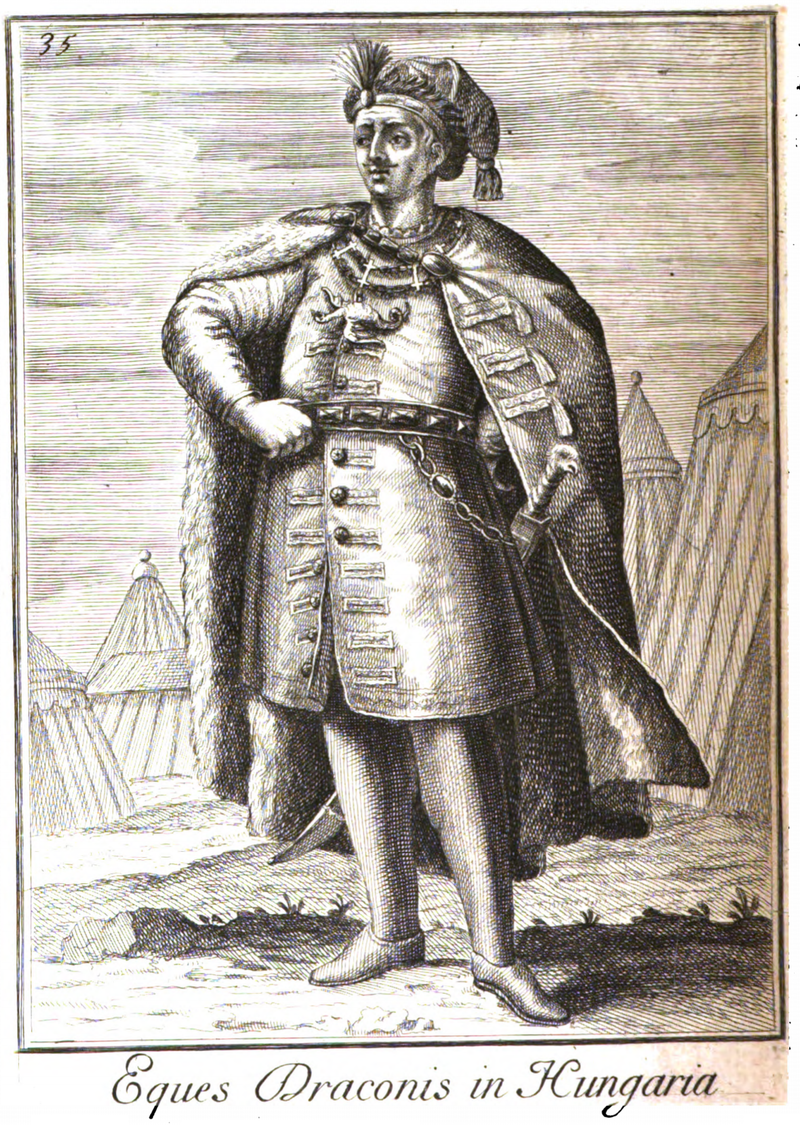
Sigismund was buried with the emblem of the “Dragon around the Neck” on 9 December 1437. On 20 January 1438, a commemorative ceremony for Sigismund of Luxembourg was held in the cathedral of Ragusa (present-day Dubrovnik). Sigismund, who had been king and emperor of numerous kingdoms and was commemorated throughout many regions of Europe, was honoured with religious services, the ringing of bells, and solemn speeches.
Ragusa was no exception. Here, before an exclusive audience, the Italian scholar Filippo Diversi († 1452) delivered a speech in memory of the deceased. Filippo first outlined Sigismund’s connection with Ragusa before turning to the emperor’s greatest achievement: Sigismund’s commitment to the unity of the Church, evident in his efforts against the Ottomans and the Hussites. Entire countries, including “Italy, Germany, Spain, Gaul, England, all the regions beyond the Alps, all peoples and nations”, and even “the earth and all the seas, rivers, mountains, valleys and, finally, all the elements”, had witnessed Sigismund’s deeds.
Filippo Diversi’s commemorative speech was not the only example of the esteem in which Sigismund of Luxembourg was held. As King of Hungary (from 1387), King of the Romans (from 1410/1411), King of Bohemia (from 1419), and Holy Roman Emperor (from 1433), the Luxembourg ruler enjoyed a positive and enduring reputation, documented by numerous contemporary and later chroniclers, ambassadors, and men of letters.
Sigismund’s death dealt a severe blow to the Order. The Order of the Dragon gradually fell into oblivion in the following years, during a period in which Hungary was largely conquered by the Turks. Nevertheless, following the fall of Constantinople in 1453, the Order continued to play an important role in Hungary itself, as well as in Croatia, Serbia, Romania, and Albania, until 1688.
In many respects, Sigismund’s impact extends far beyond the laudatory narratives of early humanism or later historical accounts. Sigismund brought together a vast mosaic of territories, languages, legal traditions, and cultural norms in Central and Southeastern Europe. This complexity made diversity one of the defining characteristics of his empire.
Nevertheless, until the seventeenth century, the circular Dragon, strangled by its own tail, continued to appear on the coats of arms of many noble families of the Hungarian and Romanian realms, whose ancestors included some of the knights who had belonged to the Order of the Dragon during the reign of Sigismund.
The Wallachian Prince Vlad II Dracul, father of Vlad the Impaler, adopted the name Dracul (“the Dragon”) in connection with the Order of the Dragon and his membership in it. This provides further evidence of the considerable prestige enjoyed by the Order of the Dragon throughout the first half of the fifteenth century.